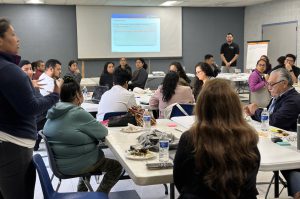
Growing Opportunities in Southeast Los Angeles
Advancing a Collaborative Agenda in Southeast LA Published on August 18, 2026 The Southeast Community For decades, the cities, neighborhoods, and unincorporated areas between the

Variable Definitions:
American Indian/Native Population: The percentage of the population that identifies as Non-Hispanic American Indian/Native
American Indian/Native Population, including in Combination with Other Race/Ethnicity: The percentage of the population that identifies as any part American Indian/Native. This includes Non-Hispanic American Indian/Native, Hispanic American Indian/Native, and American Indian/Native in combination with any other race.
Asian Population**: The percentage of the population that identifies as Non-Hispanic Asian
Black Population: The percentage of the population that identifies as Non-Hispanic Black
Hispanic/Latino/a Population: The percentage of the population (of any race) that identifies as Hispanic/Latino
Native Hawaiian/Other Pacific Islander Population: The percentage of the population that identifies as Non-Hispanic Native Hawaiian/Other Pacific Islander
Other Race Population**: The percentage of the population that identifies as Non-Hispanic and “Other Race”
Population of Two or More Races: The percentage of the population that identifies as Non-Hispanic and two or more races
White Population: The percentage of the population that identifies as Non-Hispanic White
Source:
1990 & 2000: Decennial Census (accessed through Social Explorer)
2010 Onward: American Community Survey (ACS), 5-year estimates, Table B03002, B02010
Years Available*:
1990, 2000, 2010 – 2024
*Note: Each year of available data shown above is a 5-year estimate, or an average of data collected over a five year period. 5-year estimates are used to increase the reliability of the data at small geographies like neighborhoods and census tracts. The years shown on the NDSC map represent the final year of the five year average (e.g. “2010” represents 2006-2010 data, “2011” represents 2007-2011 data, and so on). For the most impactful comparison of data over time, the ACS recommends comparing non-overlapping years (e.g. 2010-14 with 2015-19).
**For 1990 data only, Asian Population includes both Asian and Pacific Islander. Other Race includes Two or More Races. In 2000 onward, these variables were separated into distinct measures.
The racial classifications used by the Census Bureau reflect a social definition of race recognized in the United States, not a biological, anthropological, or genetic definition. Most modern scientists agree that race has no biological element. Scholars typically concur that the concept of race changes over time and is understood based on geography, language, and culture, making it more a social construct than a fact.
The Census Bureau definitions for race and ethnicity are a key example of how our understandings of race constantly evolve. For example, even though the census survey began in 1790, it wasn’t until 1860 that the racial category of “Indian” was added for Indigenous individuals. And it wasn’t until 2000 that this category was expanded to include “American Indians or Alaska Natives,” along with a blank space to specify a tribe. The categories of “Asian” and “Hispanic” originally started as only “Chinese” and “Mexican,” respectively, and only over time expanded to include other countries of origin and options for other countries not listed.
Even today, the Census Bureau is changing the way questions of race & ethnicity are asked to obtain more granular race data. In March 2024, the Census Bureau announced it would combine race & ethnicity into one question, giving the option for respondents to choose multiple categories that more accurately encapsulate their identity. Previously, when the survey would ask about being Hispanic/non-Hispanic and race separately, more than 43% of Hispanic people skip or select “some other race” for the race question, due to common perceptions of race and ethnicity to be very similar. The survey will also, for the first time, offer a category for “Middle Eastern and North African” people who were previously encouraged to select the “White” category despite most not identifying that way.
Although race is a social construct, including it in conversations regarding structural inequities and discrimination is vital for social change. Everyone has a racial identity that is both created by ourselves (how we identify ourselves) and placed on us (how others perceive us). Most Black, Hispanic, and Asian Americans report seeing their race and/or ethnicity as extremely important to their overall identity. Furthermore, measuring racial disparity is an important tool for policymakers in many areas including health, employment and income, housing, and education. During the COVID-19 pandemic, the Centers for Disease Control and Prevention identified a high rate of coronavirus transmission across Native Americans; this would not have been possible if “American Indians or Alaska Natives” was not an official race category on government forms. Understanding how race influences our experiences and recognizing the advantages and/or disadvantages that are associated with our racial identities can allow us to achieve racial equity – a world in which a person’s race doesn’t predict what their life will be like.
A Note on American Indian/Native Population Data
There is a longstanding, complicated relationship between the Census and American Indian/Alaska Native populations. The Census Bureau initially excluded Native people entirely because many lived in sovereign tribal communities considered to be outside the United States. The first tribal count was done by the Commissioner of Indian Affairs in 1850. Ten years later, the Census Bureau allowed only Native Americans who had renounced their tribal affiliation to be included in the general population count. The Indian Citizenship Act (1924) paved the way for the inclusion of Native American and Alaska Natives in the general census population. Native counts grew in 1970 when the Census Bureau conducted its first census survey via mail, allowing Native people to self-report their race and their tribal affiliation. Native American Indian and Alaska Native counts continued to increase when the Census later updated the survey to allow respondents to select more than one race.
Undercounts of Native people during crises lead to underresourcing, as governments make decisions based on data reporting (Robeznieks, 2020). During COVID-19 pandemic, Native people were not prioritized or given adequate personal protective equipment to mitigate outbreaks in their communities due to undercounts of infections and deaths (Smith, 2020).
Respondents to the Census can select Hispanic or non-Hispanic for ethnicity, and then as many race categories as they see fit; the American Indian and Alaska Native race category is one of the options. Usually, race and ethnicity data are presented on NDSC by first showing the share of the population that identifies as Hispanic/Latino; then, the remaining population is classified as their selected race category (or multi-racial). However, a unique issue arises for Native people, who often identify as Hispanic or another race in conjunction with their Native identity. In Southern California specifically, many Native Americans identify as Hispanic indigenous Mexicans. As a result, NDSC decided to expand the data available for the American Indian/Alaska Native (AIAN) population in October 2026; in addition to sharing data for exclusively non-Hispanic, AIAN individuals, we also share data for all AIAN individuals, regardless of ethnicity or other races selected.
Written by Cameron Yap & Marisol De La Torre
Citation:
Brown, A. (2020 Feb 25). The changing categories the U.S. census has used to measure race. https://www.pewresearch.org/short-reads/2020/02/25/the-changing-categories-the-u-s-has-used-to-measure-race/
Coates, T. (2013, May 15). What We Mean When We Say ‘Race Is a Social Construct?’. The Atlantic. https://www.theatlantic.com/national/archive/2013/05/what-we-mean-when-we-say-race-is-a-social-construct/275872/.
Gannon, M. (2016, February 5). Race Is a Social Construct, Scientists Argue. Scientific American. https://www.scientificamerican.com/article/race-is-a-social-construct-scientists-argue/
Horowitz, J.M., Brown, A., & Cox, K. (2019, April 9). Race in America 2019. Pew Research Center. https://www.pewresearch.org/social-trends/2019/04/09/the-role-of-race-and-ethnicity-in-americans-personal-lives/.
“Race and Racial Identity”. (n.d.). National Museum of African American History & Culture. https://nmaahc.si.edu/learn/talking-about-race/topics/race-and-racial-identity.
Robeznieks, A. (2020, April 24). National COVID-19 patient data vital to fixing inequity. American Medical Association. https://www.ama-assn.org/public-health/optimal-health/national-covid-19-patient-data-vital-fixing-inequity
Schneider, M. (2024, Mar 28). US changes how it categorizes people by race and ethnicity. It’s the first revision in 27 years. Associated Press News. https://apnews.com/article/race-ethnicity-census-bureau-hispanics-0b2c325b683efd95e8e8e24235654abd
Skibba, R. (2019, May 20). The Disturbing Resilience of Scientific Racism. Smithsonian Magazine. https://www.smithsonianmag.com/science-nature/disturbing-resilience-scientific-racism-180972243/
Smith, T. M. (2020, May 13). Why COVID-19 is decimating some Native American communities. American Medical Association. https://www.ama-assn.org/public-health/population-health/why-covid-19-decimating-some-native-american-communities
True Colors United. Racial Equity Toolkit. https://truecolorsunited.org/wp-content/uploads/Racial-Equity-Toolkit-2021_v3.pdf
U.S. Census Bureau. (2024, August 14). Censuses of American Indians. https://www.census.gov/about/history/census-records-family-history/census-records/censuses-of-american-indians.html
Zraick, K., McCann, A., Almukhtar, S., Parshina-Kottas, Y. & Gebeloff, R. (2024, Feb 25). No Box to Check: When the Census Doesn’t Reflect You. https://www.nytimes.com/interactive/2024/02/25/us/census-race-ethnicity-middle-east-north-africa.html?campaign_id=9&emc=edit_nn_20240226&instance_id=116078&nl=the-morning®i_id=75695506&segment_id=159155&te=1&user_id=c062c2a0fb63b42ab9ce5528280698b6
Advancing a Collaborative Agenda in Southeast LA Published on August 18, 2026 The Southeast Community For decades, the cities, neighborhoods, and unincorporated areas between the
Advancing a Collaborative Agenda in Southeast LA In 2022, the California Community Foundation (CCF) launched the Regional Recovery Hub to strengthen place-based coordination in Los Angeles County

Every ten years, the federal government conducts a “census,” where it counts every person living in the United States. The constitution mandates that all people